
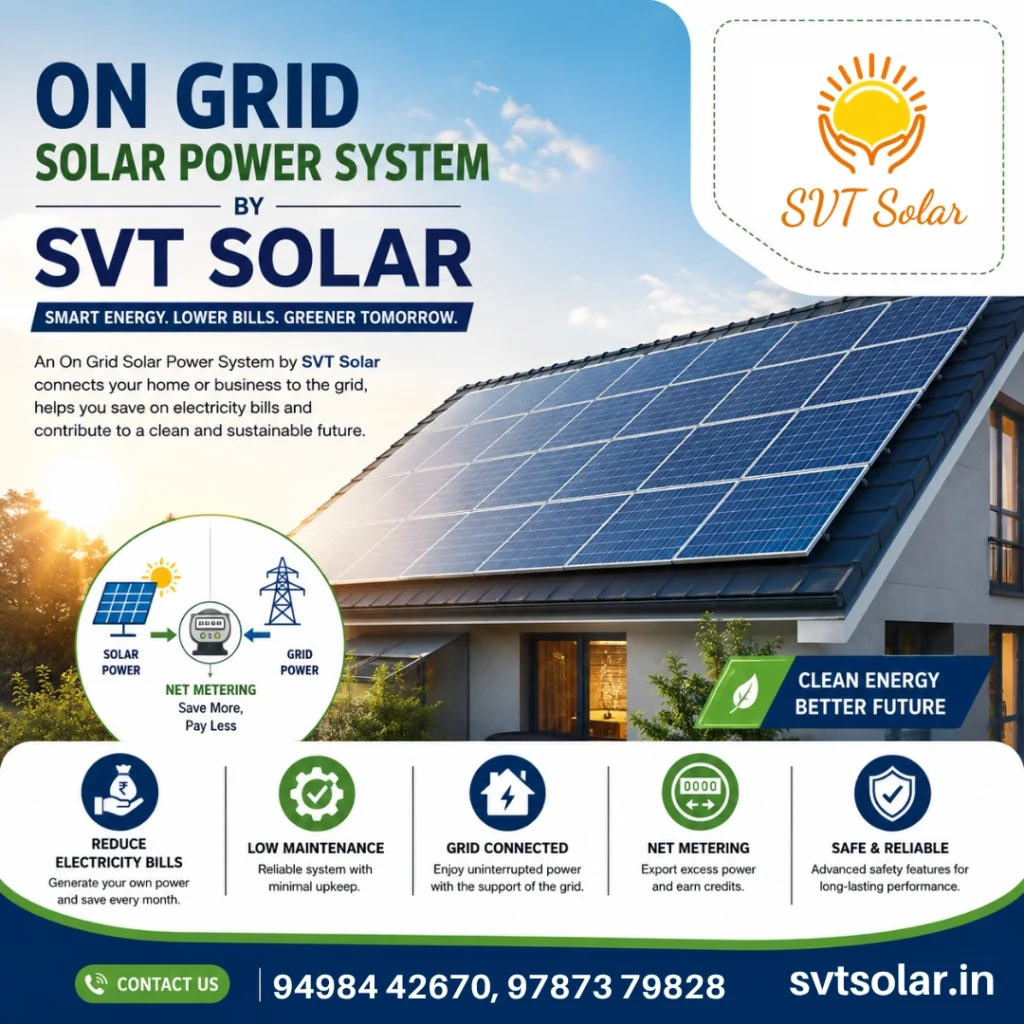
On Grid Solar Power System by SVT Solar
On Grid Solar Power System by SVT Solar is an efficient solar energy solution for homeowners and businesses looking to reduce their dependence on conventional electricity and manage rising power costs. As solar energy becomes increasingly popular, understanding how a grid-connected solar system works can help property owners make better decisions about their energy requirements.
Unlike an off-grid solar setup, an on-grid system remains connected to the local electricity grid. It allows solar panels to generate electricity during daylight hours, while excess power can be exported to the grid according to the applicable electricity regulations and metering arrangement. When solar generation is insufficient, electricity can be drawn from the utility grid.
This combination of solar generation and grid connectivity makes on-grid solar systems a practical option for properties with reliable grid electricity.
What Is an On Grid Solar Power System?
An on-grid solar system, also known as a grid-tied or grid-connected solar system, is a photovoltaic power setup connected directly to a property’s electrical system and the local utility grid.
On Grid Solar Power System by SVT Solar can be considered by homeowners, commercial establishments, offices, shops, institutions, and other properties that want to use solar-generated electricity while remaining connected to the existing power network.
One of the major differences between on-grid and off-grid systems is battery storage. A standard on-grid system generally does not require a large battery bank for storing electricity. Instead, electricity generated by the solar panels is used by connected loads, while surplus generation may be exported to the grid and electricity can be imported when solar generation is insufficient, subject to the applicable net-metering or other approved metering mechanism.
This can make an on-grid system comparatively simpler than a battery-based off-grid installation.
How Does an On Grid Solar Power System Work?
The operation of an on-grid solar installation can be understood through a simple sequence. Solar panels generate electricity from sunlight, an inverter converts the generated electricity into usable AC power, and the property’s electrical loads consume the available solar power.
1. Sunlight Absorption
Photovoltaic solar panels installed on the roof or another suitable location absorb sunlight and convert solar energy into direct current electricity.
The amount of electricity generated depends on several factors, including sunlight availability, panel capacity, installation orientation, shading, weather conditions, and system design.
2. Power Conversion
Solar panels produce DC electricity, while most household and commercial electrical appliances operate using AC electricity.
The grid-connected inverter converts the DC electricity generated by the solar panels into AC electricity suitable for use within the property and synchronizes the system with the electrical grid.
3. Electricity Consumption
The generated electricity can be used by appliances and electrical equipment operating within the property.
Refrigerators, lighting systems, computers, fans, pumps, air conditioners, machinery, and other suitable electrical loads can consume solar-generated electricity when the system is producing power.
4. Surplus Solar Power
Solar panels may sometimes generate more electricity than the property is consuming at that particular moment.
Depending on the approved metering arrangement, excess electricity can flow into the utility grid through the appropriate meter. This allows the energy generated by the solar installation to be accounted for according to the applicable electricity regulations.
5. Grid Electricity
Solar generation changes throughout the day. At night, solar panels do not generate electricity, while cloudy weather or other conditions can reduce production.
When the property’s electricity requirement exceeds the available solar generation, electricity can be supplied from the utility grid.
6. Net Metering
A bidirectional meter can measure electricity flowing in both directions where net metering is approved and applicable.
The meter records electricity imported from the grid and electricity exported to the grid. The applicable billing mechanism then determines how these units are accounted for according to the prevailing regulations and utility policies.
Main Components of an On-Grid Solar System
A properly designed grid-connected solar installation consists of several important components that work together.
Solar Panels
Solar panels are the primary electricity-generating components. They convert sunlight into DC electrical energy.
The number and capacity of panels required depend on the property’s electricity consumption, available installation area, solar resource, system capacity, and other design considerations.
Grid-Tied Inverter
The inverter is an essential component of an on-grid solar system. It converts DC electricity from the panels into AC electricity and manages synchronization with the electrical grid.
Inverter selection should consider system capacity, efficiency, protection features, compatibility, installation conditions, and manufacturer specifications.
ACDB and DCDB
AC and DC distribution boxes provide electrical protection and isolation for appropriate parts of the solar installation.
They can include protective devices designed to help protect the system against electrical faults and other specified conditions.
Solar Cables and Connectors
Suitable solar cables and connectors are required to safely connect the photovoltaic modules, inverter, and other system components.
Correct cable sizing and proper installation are important for efficient and safe system operation.
Net Meter
Where applicable, a bidirectional or net meter records electricity flowing between the property and the utility grid.
Metering arrangements depend on the local electricity distribution authority and applicable regulations.
Benefits of an On-Grid Solar System
On Grid Solar Power System by SVT Solar can provide several potential advantages for properties with suitable electricity consumption patterns and grid connectivity.
Reduced Electricity Costs
Solar generation can reduce the amount of electricity a property needs to purchase from the utility during periods when solar power is available.
The actual savings depend on electricity consumption, system size, solar generation, tariff structure, export rules, and other factors.
No Large Battery Bank in a Standard Setup
Because the system remains connected to the utility grid, a conventional on-grid installation generally does not require a large battery bank.
This can simplify the system compared with many off-grid installations and avoids the routine maintenance and eventual replacement associated with battery storage.
Efficient Use of Rooftop Space
Rooftops and other suitable areas can be used to install solar panels and generate electricity from available sunlight.
Proper site assessment is important to determine whether sufficient shadow-free space is available.
Potentially Lower System Complexity
A grid-connected solar system can be less complex than a fully independent solar installation because it does not normally depend on large batteries for energy storage.
However, electrical protection, approvals, metering, and professional installation remain important.
Renewable Energy Generation
Solar energy is a renewable source of electricity. Generating a portion of a property’s electricity from sunlight can reduce dependence on conventional grid electricity.
Important Safety Consideration During Power Outages
One important point that property owners should understand is that a standard on-grid solar system generally does not continue supplying electricity during a utility power outage.
The grid-connected inverter is designed to disconnect from the utility network when the grid goes offline. This is an important safety function that helps prevent solar electricity from being unintentionally fed into lines that utility personnel may be working on.
Therefore, homeowners who require backup electricity during power cuts should discuss suitable battery storage or backup-capable solar solutions with a qualified solar professional.
A standard grid-tied installation should not be assumed to provide emergency backup power.
Is an On-Grid Solar System Suitable for Your Property?
On Grid Solar Power System by SVT Solar may be suitable for properties where the primary objective is reducing electricity purchases while maintaining a connection to the utility grid.
Before installation, property owners should evaluate their monthly electricity consumption, daytime energy usage, rooftop availability, shading conditions, electrical infrastructure, sanctioned load, and applicable utility requirements.
Daytime electricity consumption is particularly relevant because solar panels generate electricity primarily during daylight hours. Properties that consume significant electricity during the day may be able to use a greater portion of their solar generation directly.
A professional site assessment can help determine the appropriate system configuration.
Factors to Consider Before Installation
Choosing a solar system should involve more than simply comparing panel capacity or installation prices.
Electricity Consumption
Reviewing previous electricity bills can help determine average energy consumption and identify seasonal changes.
Rooftop Condition
The roof should be assessed for structural suitability, available space, accessibility, and installation conditions.
Shading
Nearby buildings, trees, water tanks, structures, and other obstructions can affect solar generation.
System Capacity
The solar capacity should be selected according to electricity consumption, available space, applicable regulations, and the property’s energy requirements.
Inverter Selection
The inverter should be compatible with the planned solar array and electrical system.
Metering and Approvals
Grid-connected solar installations may require applications, inspections, approvals, and meter-related procedures depending on the local distribution utility and applicable rules.
Maintenance of an On-Grid Solar System
Solar systems generally require routine inspection and maintenance to maintain reliable performance.
Solar panels should be kept reasonably clean because accumulated dust and dirt can affect energy generation. The frequency of cleaning depends on the local environment.
Electrical connections, cables, mounting structures, inverter operation, protective devices, and other components should also be inspected periodically by qualified personnel.
Monitoring system generation can help identify unusual performance changes. If electricity generation drops significantly without an obvious environmental reason, the system should be inspected.
Following the manufacturer’s recommendations and using qualified technicians for electrical work can support safe operation.
Why Choose SVT Solar for Grid-Connected Solar Solutions?
On Grid Solar Power System by SVT Solar represents a solar solution focused on using photovoltaic energy while maintaining grid connectivity.
When evaluating a solar provider, customers should consider technical design, installation quality, component selection, documentation, system sizing, electrical safety, service support, and assistance with applicable utility procedures.
A properly designed system should be based on the property’s actual electricity requirements rather than using a standard configuration for every customer.
SVT Solar can be considered by customers looking to explore grid-connected solar solutions based on their individual energy requirements and site conditions.
Applications of On-Grid Solar Systems
Grid-connected solar systems can be considered for a variety of properties, including:
- Independent houses
- Villas
- Apartments where permitted
- Offices
- Commercial buildings
- Retail shops
- Schools and educational institutions
- Small industries
- Warehouses
- Clinics
- Hotels
- Restaurants
- Workshops
- Institutional buildings
The appropriate system capacity and configuration will vary according to the electricity consumption and physical characteristics of each property.
Frequently Asked Questions
What is an on-grid solar system?
An on-grid solar system is a photovoltaic electricity system connected to both the property’s electrical network and the utility grid. Solar electricity can be used by the property, while surplus generation may be exported according to the approved metering arrangement.
Does an on-grid solar system require batteries?
A standard grid-connected system generally does not require batteries. The utility grid provides electricity when solar generation is insufficient. Battery storage can be added when backup power or energy storage is specifically required.
Does an on-grid solar system work during a power cut?
A standard grid-tied inverter normally shuts down when the utility grid goes offline. This prevents unintended electricity export to the utility network. A backup-capable system with appropriate equipment is required for power-outage operation.
What is net metering?
Net metering is a metering arrangement that can account for electricity imported from and exported to the grid, where approved by the relevant electricity authority. The exact rules and billing mechanism depend on local regulations.
Can solar panels reduce electricity bills?
Solar generation can reduce electricity purchased from the grid. The amount saved depends on factors such as system capacity, solar generation, electricity consumption, tariffs, export arrangements, and applicable utility policies.
How much solar capacity does a home need?
There is no single capacity suitable for every home. The appropriate size depends on electricity consumption, available rooftop space, solar conditions, budget, electrical infrastructure, and applicable regulations.
How often should solar panels be cleaned?
Cleaning frequency depends on dust, pollution, weather, bird activity, and the surrounding environment. Panels should be inspected periodically and cleaned when necessary using appropriate procedures.
Conclusion
Solar energy provides property owners with an opportunity to generate electricity from a renewable source while reducing reliance on conventional grid electricity. For properties with a reliable utility connection, grid-connected solar can be a practical way to use solar generation without depending on a large battery bank.
On Grid Solar Power System by SVT Solar can be considered by homeowners, businesses, institutions, and other electricity consumers interested in adopting grid-connected solar technology.
The system works through an integrated combination of photovoltaic panels, a grid-tied inverter, electrical protection equipment, suitable cabling, and an approved metering arrangement. Solar electricity is generated during daylight hours, consumed by connected loads, and surplus power may be exported to the grid where permitted. When solar generation is insufficient, electricity can be imported from the utility grid.
Before investing, customers should carefully assess electricity consumption, rooftop suitability, shading, system capacity, equipment specifications, installation requirements, metering procedures, and applicable regulations.
On Grid Solar Power System by SVT Solar offers a practical concept for customers looking to combine solar electricity generation with existing grid connectivity. With proper system sizing, professional installation, regular maintenance, and compliance with applicable electrical and utility requirements, an on-grid solar installation can become an important part of a property’s long-term energy strategy.
For anyone considering solar for a home, commercial property, office, shop, or industrial facility, On Grid Solar Power System by SVT Solar can be explored according to individual electricity requirements, site conditions, and local grid regulations.
Contact SVT Solar or Visit our location directly for more detailed informations.